
Rates are changing
A closer look at the key forces shaping today's home-loan market.
The question
The signal
Banks are responding to changing demand and competitive conditions.
What changed
01
Policy
02
Liquidity
03
Competition
04
Festive demand
05
Outlook
The numbers
0.00%
Current reference rate
Illustrative / demo dataWhat to watch
The market
Four shifts worth tracking before you compare a single lender's offer.
A closer look at the key forces shaping today's home-loan market.
Buyers are adjusting their budgets, timelines, and expectations as borrowing costs evolve.
Interest rates are only one part of the story. Inflation, economic growth, housing demand, and lender competition all play a role.
Instead of focusing on a single number, understand the trends that could influence borrowing decisions over time.
Home loan rates don't move in isolation. Behind every percentage point is a broader economic story — from inflation and central-bank decisions to housing demand and the cost of funding.
Look beyond the headline rate.
Explore the signals, understand what is changing, and see how the pieces connect.
How inflation, growth, and monetary policy can influence borrowing costs.
What demand, supply, and buyer sentiment mean for the market.
How changing rates can affect affordability, repayments, and home-buying decisions.
Read in full
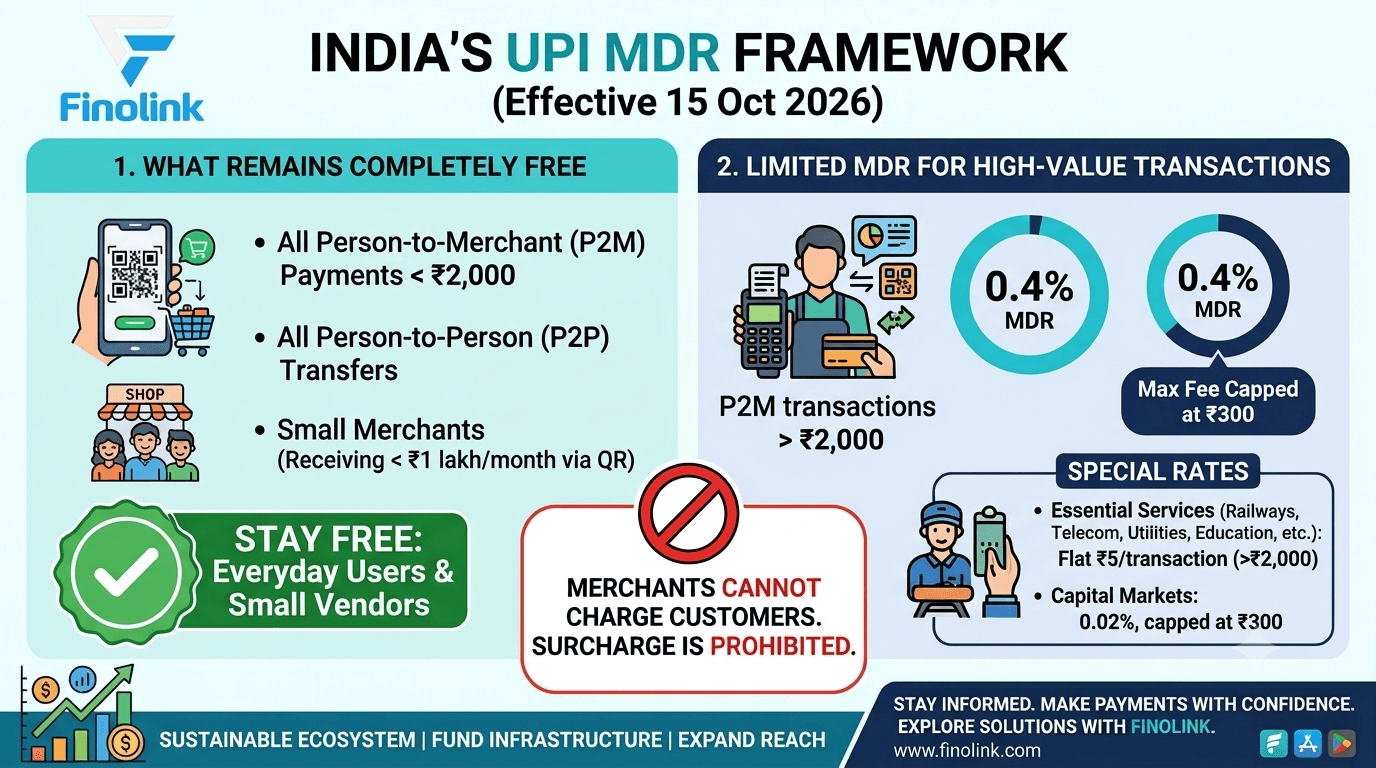
From 15 October 2026, India’s UPI ecosystem will introduce a limited Merchant Discount Rate (MDR) while keeping everyday payments completely free for users. This update aims to make the digital payments infrastructure more sustainable without burdening common people or small businesses.
At Finolink, we believe clear information helps everyone — users, merchants, and businesses — prepare better. Here’s a simple breakdown of the new framework.
What Remains Completely Free
All person-to-person (P2P) transfers All consumer payments to merchants (any amount) - Person-to-merchant (P2M) transactions up to ₹2,000 Small merchants receiving up to ₹1 lakh per month via UPI QR
These categories cover the vast majority of daily UPI transactions, including payments to street vendors, kirana stores, and everyday transfers.
What Changes for Merchants
Only higher-value commercial transactions are affected:
P2M transactions above ₹2,000: 0.4% MDR Maximum fee capped at ₹300 (for transactions of ₹75,000 and above)
Special rates apply for certain sectors:
Essential and thin-margin sectors (railways, telecom, insurance, fuel, utilities, education, agricultural inputs, etc.): Flat ₹5 per transaction above ₹2,000 Capital market transactions (mutual funds, stockbrokers, etc.): 0.02%, also capped at ₹300
Key takeaway
From 15 October 2026, UPI remains completely free for consumers. Merchants will pay a limited 0.4% MDR only on higher-value transactions above ₹2,000, capped at ₹300. Small merchants and everyday users stay protected.
Important: Merchants are not allowed to pass this MDR on to customers. Any surcharge is prohibited.
Quick Examples
| Transaction Value | A completely free model for all merchants became difficult to sustain as transaction values and volumes grew. The new structure helps:
Fund critical infrastructure, security, and system reliability - Support expansion into smaller towns and rural areas Create a balanced model that protects everyday users and small merchants
At the same time, the design deliberately keeps the impact away from ordinary consumers and micro-vendors.
Final Takeaway
For ordinary users, nothing changes — UPI remains free. For small merchants, strong protection continues. Only higher-value commercial transactions will contribute a limited fee to keep the ecosystem healthy and future-ready.
Stay informed and make digital payments with confidence.
Want to accept UPI payments smoothly for your business? Explore reliable payment solutions with Finolink.
The impact
Lenders want festive-season volume, so offers are softer than the headline rate.
Watch for — Compare at least three lenders before you commit.
Ask your lender — Is this rate fixed, or linked to the repo rate?
Processing fees and prepayment charges can outweigh a tenth of a percent on the rate.
Watch for — Ask for the total cost over the full tenure, not just the EMI.
Ask your lender — What does the loan actually cost me over its lifetime?
A floating-rate EMI moves only when the RBI moves the repo rate.
Watch for — Track the policy review every two months.
Ask your lender — What would it cost me to refinance?
Sources & references
RBI
Monetary Policy Statement · 14 Sep 2026
Economic Times
RBI holds repo rate steady · 14 Sep 2026